
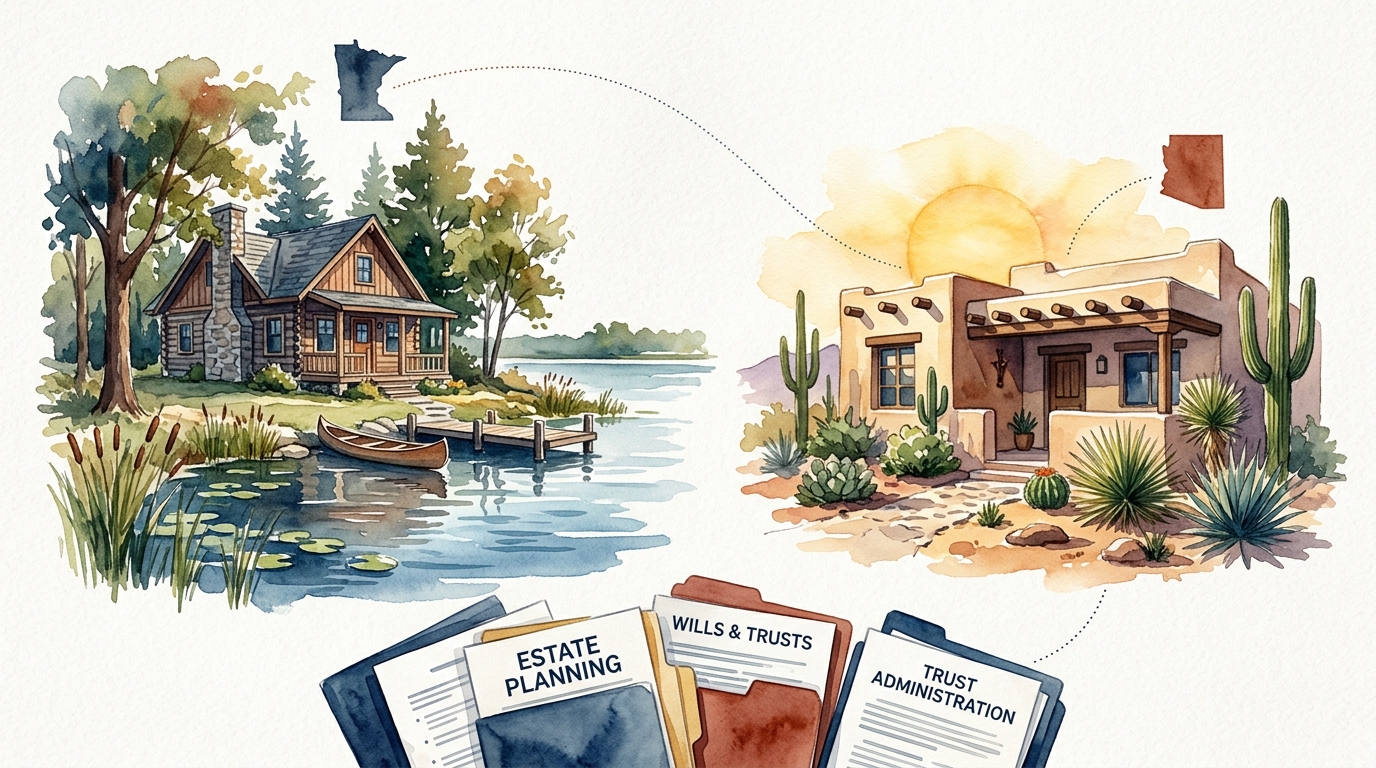
If You Winter in Arizona, Does Minnesota Still Tax Your Estate?
For Minnesota snowbirds, spending part of the year in Arizona or Florida does not automatically change estate-tax residency. Minnesota estate tax generally turns on domicile: the place a person considers their permanent home and intends to return to, even when away. The separate Minnesota income-tax “183-day” statutory-residency test matters for income taxes, but it is not the estate-tax residency test.
At Syverson PLLC, we help families throughout Minnesota consider how residence, property ownership, and estate-planning documents work together. A move is often more than a change of winter address; the details of a person’s records, conduct, property, and long-term intentions can all matter.
Domicile Is the Estate-Tax Question
Minnesota’s estate-tax law generally treats a decedent as a Minnesota resident if the person was domiciled in Minnesota at death. In plain language, domicile is a person’s true, fixed, and permanent home—the place they intend to return to after an absence. A person has only one domicile at a time, although they may own and use homes in more than one state.
This is why a Minnesota resident who winters in Florida or Arizona should not assume that time away, standing alone, settles the estate-tax question. A seasonal pattern may be entirely consistent with remaining domiciled in Minnesota. On the other hand, a genuine, well-documented relocation can support a conclusion that domicile changed. The answer depends on the full set of facts, not one document or one number of days.
Minnesota Department of Revenue guidance and Minnesota authorities analyze domicile through a person’s intent as shown by objective actions. The analysis is practical: Where is the person’s primary home? Where do they return? Which address appears on government, financial, medical, and legal records? Where are the relationships, routines, and personal connections centered?
The Different 183-Day Rule for Income Taxes
The frequently discussed 183-day standard comes from Minnesota’s income-tax residency rules. Under Minnesota Statutes section 290.01, a person may be a Minnesota “statutory resident” for income-tax purposes when the person maintains a permanent place of abode in Minnesota and spends more than one-half of the tax year in Minnesota—generally, more than 183 days in a 365-day period.
That rule is separate from domicile. A person can be domiciled outside Minnesota yet be treated as a Minnesota statutory resident for income-tax purposes if the statutory requirements are met. Conversely, carefully staying below the day-count threshold does not by itself establish a new domicile for estate-tax purposes.
For snowbirds, that distinction is important. A travel calendar can be useful evidence and may be essential for income-tax planning, but it is not a guaranteed estate-tax safe harbor. Minnesota domicile rules examine the overall story told by a person’s life, not merely the number of nights spent in one state.
What May Evidence a Change—or Continuation—of Domicile
No single factor decides domicile. Minnesota administrative rules identify many facts that may be relevant, including where a person votes; holds a driver’s license; registers vehicles; receives mail; claims a homestead classification; uses doctors, financial institutions, and professional advisers; participates in community activities; and keeps valuable personal possessions.
Estate-planning documents may also be part of the broader picture. A will, trust, power of attorney, or living will should accurately reflect a client’s current circumstances, but changing an address in one document alone does not determine domicile. Consistency matters. For example, an individual who says Florida is home while retaining a Minnesota homestead, Minnesota driver’s license, Minnesota voter registration, primary medical care, and a Minnesota-centered daily life may have facts pointing in different directions.
Likewise, a person who truly relocates may take coordinated steps over time: establishing a primary home in the new state, updating official records, moving important personal items, building local ties, and aligning estate-planning and financial records with the move. These actions are evidence, not a formula. Intent remains central, and each situation deserves an individualized review.
A Minnesota Lake Cabin Can Complicate the Picture
Consider a couple who owns a lake cabin in Crow Wing County and a home in Arizona. They spend winters in Arizona, but return to the cabin every spring, receive substantial mail in Minnesota, see Minnesota health-care providers, maintain Minnesota licenses and voting registration, and describe the cabin as “home.” Those facts could be relevant to whether Minnesota remained their domicile, even if they spent many months each year elsewhere.
Now consider a different scenario. A retiree makes Arizona the center of daily life, moves there permanently, changes state-issued records and mailing addresses, establishes health care and community involvement there, and treats the Minnesota cabin as a limited-use vacation property. That pattern may support a different domicile analysis. Yet owning the cabin still has estate-planning consequences.
In either scenario, the lake cabin is Minnesota real property. Ownership of Minnesota real estate can remain relevant even when the owner is not domiciled in Minnesota at death.
Nonresidents May Still Have Minnesota Estate-Tax Exposure
A nonresident’s estate is not necessarily outside Minnesota estate-tax rules. Minnesota estate-tax statutes include Minnesota-situs real property and certain tangible personal property in the calculation for a nonresident estate. For example, a Minnesota lake cabin and tangible items physically located in Minnesota may be relevant even if the owner’s domicile was Arizona or Florida.
That does not mean every nonresident estate owes Minnesota estate tax. The applicable filing and tax consequences depend on the estate’s value, the statutory exclusion amount in effect for the year of death, the location and character of assets, and other facts. Estate-tax thresholds can change by legislation, so it is important to confirm the current Minnesota Department of Revenue guidance rather than rely on a dated figure or a general online checklist.
A coordinated estate plan can help identify Minnesota property, clarify ownership, and consider whether a revocable trust or other planning approach fits the family’s goals. Syverson PLLC prepares wills, trusts, powers of attorney, and living wills with attention to the practical details that families and fiduciaries may face later.
Why One Change Rarely Answers the Question
It is understandable to look for a single step that “proves” a move: buying a Florida home, obtaining an Arizona license, filing a declaration, or staying out of Minnesota for a certain number of days. Those facts may be meaningful, but none is an automatic answer to every question.
Domicile can be especially nuanced where someone maintains two well-equipped homes, owns a family cabin, continues business or community involvement in Minnesota, or splits time between states. The same facts can have different significance depending on the person’s overall history and intentions. That is why our approach to estate planning starts with listening to the full picture rather than promising a one-size-fits-all result.
Practical Steps for Snowbirds and Their Families
Good planning begins with organized information. Keep a reliable travel record, identify every property and where tangible valuables are kept, and review whether property titles, insurance, beneficiary designations, and estate-planning documents remain current. If a move is intended, consider whether official records and everyday practices consistently reflect that intention.
It is also useful to revisit a plan after a major change, such as retirement, a move, the purchase or sale of a cabin, a marriage or divorce, or a change in business ownership. For business owners, succession planning can overlap with personal estate planning, especially where a closely held company, a business-formation decision, contracts, or a future merger or acquisition is part of the family’s long-term plan.
If you are weighing Minnesota residency issues as part of your estate plan, Syverson PLLC invites you to request a free 30-minute initial estate-planning consultation. We serve families in Central Minnesota from our Sartell location and can help you identify questions to discuss with your tax and financial advisers.
FAQ
Does spending fewer than 183 days in Minnesota prevent Minnesota estate tax?
No. The 183-day concept is part of Minnesota’s income-tax statutory-residency analysis. Minnesota estate-tax residency generally focuses on domicile, which is determined from the full facts and circumstances.
Can I be a nonresident of Minnesota and still have a Minnesota estate-tax filing issue?
Potentially. Minnesota real property and certain tangible personal property located in Minnesota may be relevant to a nonresident estate. The estate’s total value and the law in effect for the year of death also matter.
Does keeping a Minnesota lake cabin mean I am still domiciled in Minnesota?
Not necessarily. A cabin is one relevant fact, and how it is used can matter. Domicile depends on the overall evidence of where you have made your permanent home and intend to return.
Should I change my will or trust after relocating?
It is wise to review your will, trust, powers of attorney, living will, beneficiary designations, and property ownership after a move or major life change. Updates should fit your actual circumstances and broader estate-planning goals.
Is a Florida or Arizona driver’s license enough to establish a new domicile?
No. A driver’s license can be relevant evidence, but Minnesota looks at the total pattern of a person’s conduct and connections. There is no single-document guarantee.
This article provides general legal information, not legal or tax advice. Residency, domicile, estate-tax, and income-tax questions are fact-specific and may involve the laws of more than one state. Consult qualified legal and tax professionals about your circumstances before making decisions.